Norfolk, Virginia: A History-Geography of First Annexations (Books 9-13, Encyclopedia of Norfolk) (365 pp.)

Regular price $64.95
As low as $45.45 with membership

Norfolk, Virginia: A History-Geography of First Annexations is a specially-priced volume that contains Books 9 to 13, all together, in one book totaling 365 pages, containing all the following:

Book 9. Norfolk, Virginia, From Town to Downtown: A History-Geography
Description of Book 9 Contents

Norfolk, Virginia, From Town to Downtown: A History-Geography (Book 9, Encyclopedia of Norfolk, Virginia, History-Geography) covers the history-geography of the oldest areas of Norfolk – the areas that were the original town as of 1635, then expanded in 1736 (when it became a borough), and expanded again in 1750, 1761, and the early 1800s, becoming the original city in 1845. It also covers the lands located just east of the original city, known as Brambleton and Mayfield, which were absorbed into the city by its First Annexation in 1887.

The areas discussed include locations once known as Back Creek, Glebe Cove, Dun In The Mire, Four Farthing Point and Old Fort, Town Point, Town Bridge, Plume’s Cove, Brigg’s Point, Allyntown, Musketo Point, Selden’s Point, Lamb’s Point, Salters Plantation, Hickory Neck, Boush’s Pasture, James’ Corner, etc. – in addition to Bramble’s Point, Mahone’s Lake, the Racefield, the Hemenway School, and Highland Terrace in Brambleton.

These early areas, which ultimately became the downtown of later, ever-expanding Norfolk, include neighborhoods later created by Redevelopment in some of the nation’s first Urban Renewal projects, such as Calvert Park (today’s Calvert Square), Young Park (today’s Young Terrace), and Tidewater Park (today’s Tidewater Gardens) – in addition to the Central Business District, Freemason Harbor, et cetera.

Their stories are told through contemporary historic maps, photographs, articles, deeds, advertisements, books and other documents.

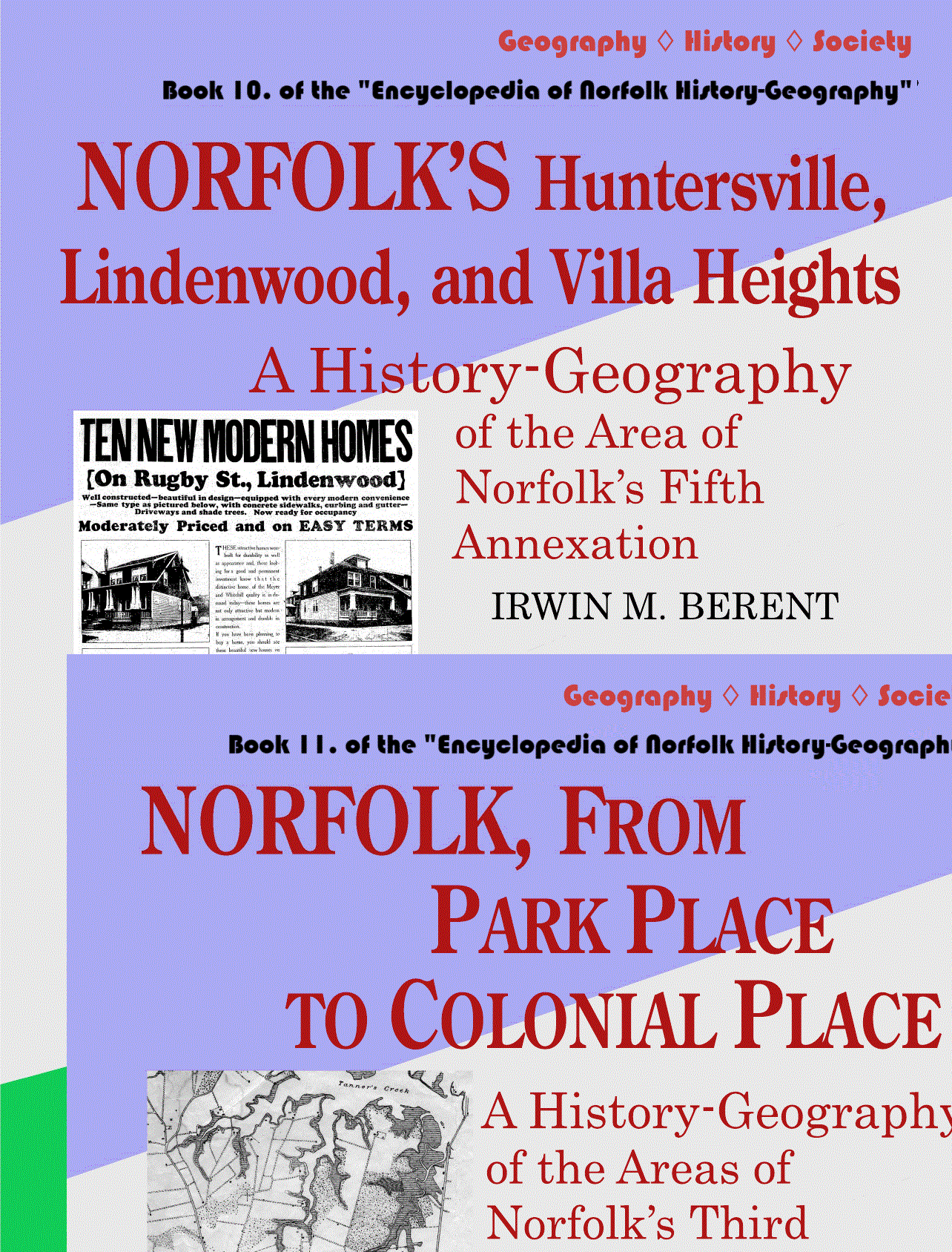
Book 10. Norfolk, Virginia’s Huntersville, Lindenwood, and Villa Heights: A History-Geography
Description of Book 10 Contents

Norfolk, Virginia’s Huntersville, Lindenwood, and Villa Heights: A History-Geography (Book 10, Encyclopedia of Norfolk, Virginia, History-Geography) covers in exhaustive detail the areas of Norfolk’s Fifth Annexation (1911) – areas known as Huntersville, Outtensville, Barboursville, Lindenwood, Villa Heights, etc., including areas earlier known as North End, Hallsville, Woodland, Farmingdale, West Point, Elmwood, Sycamores, Borderville, Wetwood and Ward’s Farm, Oak Hall, the Old Fairgrounds, Hankins’ Cottage Place and the Linden (River), Villa Park, Elizabeth Heights, Riddick Heights (Barboursville), Springfield and Whitehead’s Pond and Ridley’s Pond, East End Heights, Georgetown and George Oldfield’s brickyards, Lincoln Heights, etc.

Each is described through contemporary historic maps, photographs, articles, deeds, advertisements, books and other documents.

Book 11. Norfolk, Virginia, From Park Place to Colonial Place: A History-Geography
Description of Book 11 Contents

Norfolk, Virginia, From Park Place to Colonial Place: A History-Geography (Book 11, Encyclopedia of Norfolk, Virginia, History-Geography) covers in exhaustive detail the history-geography of all the areas within Norfolk’s Third Annexation, the Park Place Annexation of 1902, a vital part of what has made Norfolk, Virginia, one of America’s most historic and important cities.

Norfolk, Virginia, From Park Place to Colonial Place encompasses the lands located mainly north of the previously annexed territory (Atlantic City and today’s Ghent) and abutting the southern side of much of the Lafayette River (formerly Tanner’s Creek), areas known as Park Place, Virginia Place, Cruser Place, Riverview, Lafayette (City) Park, Colonial Place, Old Dominion Place, Bungalow Park, Kensington, Highland Park, and so on, lands once identified as the North End, the J.R. Young strawberry farm (said to have been the largest in the world), the lands of R.H. McDonald (temperance advocate and purveyor of California Vinegar Bitters), Riverside Park, Riverview Park, etc.

Their stories are told through contemporary historic maps, photographs, articles, deeds, advertisements, books and other documents.

Book 12. Norfolk, Virginia’s Atlantic City — or Ghent — and Lambert’s Point: A History-Geography
Description of Book 12 Contents

Norfolk, Virginia’s Atlantic City — or Ghent — and Lambert’s Point: A History-Geography (Book 12, Encyclopedia of Norfolk, Virginia, History-Geography) covers in exhaustive detail the history-geography of the areas of Norfolk’s Second and Sixth Annexations.

The book encompasses the lands located just west of the original city, areas known as Atlantic City, Ghent, East Ghent and West Ghent, the Hague, Fort Norfolk, and so on, lands once identified as Pleasant Point, Pattenween and the Thistle Distillery, Tomoko, the West End, Washington Creek, Jerusalem farm and Armistead’s Ropewalk, Llewellyn manor, Ribble Place, Lee Park, Williamston, Eureka Property, Pennock’s Point, Tarrant’s Creek/Edmond’s Creek, the Core Property, etc.

It also encompasses the lands of the Lambert’s Point Annexation, Norfolk’s Sixth Annexation (1911), located north of the eastern section of the Atlantic City Annexation. Named for the point of land jutting into the Elizabeth River and long known as Lamberts Point (and earlier said to have been called Hornet’s Point), it includes the site of the Lambert’s Point coal terminals and spans from the Elizabeth on its west to 49th Street on its north.

Their stories are told through contemporary historic maps, articles, deeds, advertisements, books and other documents that make this a magnificent resource.

Book 13. Norfolk, Virginia’s Berkley: A History-Geography
Description of Book 13 Contents

Norfolk, Virginia’s Berkley: A History-Geography (Book 13, Encyclopedia of Norfolk, Virginia, History-Geography) covers the history-geography of all the areas within Norfolk’s Fourth Annexation, the Berkley Annexation of 1906.

Separated from the original city of Norfolk to its north by the Eastern branch of the Elizabeth River, and from Portsmouth to its west by the Southern branch of the Elizabeth, Berkley was earlier known as Washington Point, Powder Point, Ferry Point, or Herbertsville, and also includes areas known as St. Helena, Montalant, Ottley Place, and so on.

Norfolk’s Berkley tells their stories through contemporary historic maps, photographs, articles, deeds, advertisements, books and other documents.


— To order an ebook version of this book, click here instead.
(All ebooks are at least $10 less than print books,
immediately downloadable, and fully searchable!)

Pay by Credit Card or PayPal®
To order Norfolk, Virginia, From Town to Downtown


Regular price $64.95
As low as $45.45 with membership

Description

The Every Square Inch of Norfolk Virginia Series

The Every Square Inch of Norfolk Virginia project, which has created The Encyclopedia of Norfolk, Virginia History-Geography, begun in 2003 under the direction of Irwin Berent, is designed to document the geographical history of the entire length and breadth of Norfolk, Virginia, one of America’s most historic cities. The culmination of this ambitious and daunting task is The Encyclopedia of Norfolk, Virginia History-Geography, the “Every Square Inch of Norfolk Virginia Series.”

Each book of the “Every Square Inch of Norfolk Virginia Series” covers a different aspect of the history, infrastructure, and people of Norfolk by examining in minute detail the geography of the entirety of the city, as defined by its current bounds. Adopting a philosophy of “historical-geographic egalitarianism,” this series covers not, as most histories of Norfolk have, merely the land that formed the original town and borough – essentially the “downtown” area – but rather also all the land that encompasses the full city limits of the current day: spanning, therefore, from Berkley, Atlantic City, Ghent, Lambert’s Point, and Larchmont to Algonquin Park, Titus Town, Riverview, Benmorreel, Glenwood Park, Sewells Point, the Naval Base, and Mason Creek; from Campostella, Huntersville, Villa Heights, Park Place, and Colonial Place to Cromwell Farm, Ward’s Corner, Monticello Village, and Willoughby Bay; from Brambleton, Roberts Park, Lindenwood, Lafayette Terrace, Winona, and Roland Park to Suburban Park, Monticello Village, Oakwood Park, Lenox, and Ocean View; from Riverside Park, Ingleside, Bowling Park, Ballentine Place, Norview, and Coronado to Chesapeake Manor, Oakwood Park, Forest Park, and Bayview Beach; from River Forest Shores, Easton Place, Fairlawn, and Admiralty Acres to Camden Heights, Camelia Acres, and Little Creek. And those are just a few of the more than 1,000 different subdivisions and geographic landmarks (and farms and plantations that preceded them) that this series covers and that make up the land – the entire land – of Norfolk.

Unlike any other treatment attempted for Norfolk (indeed, perhaps for any other city in the entire U.S.), the “Every Square Inch of Norfolk Virginia Series” covers all the major topics critical to understanding the complete breadth and depth of the geography of the city. Each of the hefty eighteen books in the series uses actual historical examples, both in words and pictures, to illustrate in minute detail one or more of those key defining topics. Each book, therefore, can separately stand alone, as each offers a rich view of some key parts of the city’s history and geography. And taken together, the series offers an extraordinarily comprehensive panorama of that history and geography.